The Writer's Technology Companion

Tools, Tips, and Technology for Productive Writers

5 Minutes Bookkeeping a Day Keeps the IRS Away

Entries Tagged ‘Software’

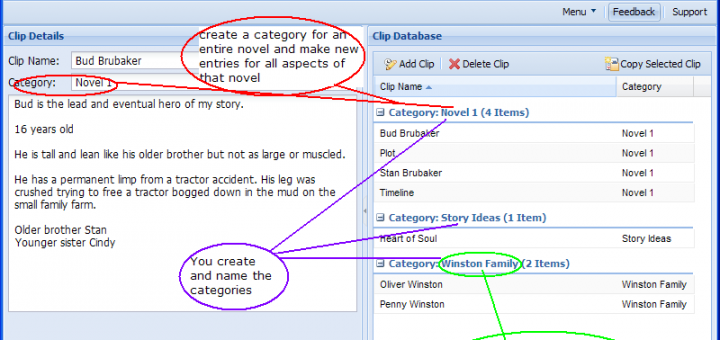
Character Keeper: Free Note-taking Software for Writers

The writers at the group blog Magical Words have developed an interesting little piece of software called Character Keeper, an AIR-based program intended to keep track of character profiles and other snippets of information related to your book. Becuase it’s AIR, Adobe’s stand-alone Flash platform, it will run on any computer that can run current […]

Comments (6)

Moving to Linux: Working with Text (Part 2)

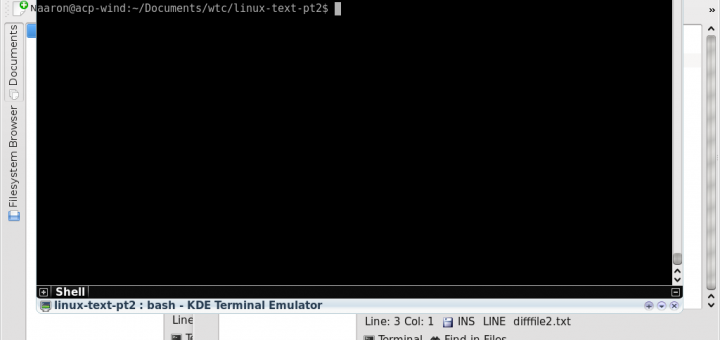
In the last installment, we examined how to compose and check your writing using the Linux tools txt2tags and aspell. Let’s assume that you’ve used these tools now — used them quite a lot. You now have several directories and sub-directories filled with dozens of text files. How to organize all of this text?
Don’t […]

Comments (1)

More on Mind-Mapping – and a Contest!

Image by sirwiseowl via Flickr

In my series on collecting and organizing ideas, I discussed mind-mapping as a brainstorming tool. Mind-mapping is a kind of free-association method in which ideas are generated by association with a central idea, and then each of the generated ideas in turn becomes a source of inspiration for further brainstorming. Mind-mapping […]

Comments (18)

"Gather Ye Rosebuds While Ye May": Tips for Collecting and Organizing Ideas, Part 4 – Organizing Your Thoughts

Image by ecstaticist via Flickr

The hardest part of any project for me is getting my notes and captured thoughts into some sort of usable format. That’s one of the reasons why I like conputerized note-taking systems like Evernote so much – it organizes for me by creating notebooks and allowing me to tag each entry.
But […]

Comments (3)

Word Passive Voice Highlighting Revisited: Now for Word 2003

Last week, I explained how to highlight uses of the passive voice in your writing, using Word 2007. Here’s how to do the same thing in Word 2003 and earlier versions.
To reiterate: the passive voice is when you explain what’s happening in such a way that the action happens to the subject rather than […]

Comments (9)

Word 2007 for Writers: Part 5 – Proofreading and Editing Tricks

I tend to prefer old-fashioned pen and paper for going over my drafts and marking revisions and edits. The screen has never struck me as a good medium for reading longer works on, and I think differently with a pen in hand than with a keyboard under my fingers.
That said, Word 2007 puts a lot […]

Comments (5)

Word 2007 for Writers: Part 4 – Fun with Sections

Chances are, you’ve learned how to insert page breaks into Word documents (Insert > Page Break, just in case). This is useful for, say, adding a “Works Cited” page at the end of a document.
But you might have seen another kind of “break” while moving through Word’s menus. They’re in a different place for some […]

Comments (5)

Word 2007 for Writers: Part 3 – Master Documents and Outlines

A book can be an unwieldy thing to write, especially on older (read: slower) hardware, and even more especially if you have illustrations, charts, and other graphic material in your file. As the document gets bigger, it gets slower and slower to open the document, to find your place, and to scroll back and forth […]

Comments (4)

Word 2007 for Writers: Part 2 – Using Styles

Styles are an incredibly useful feature in Word — which have unfortunately been rather hidden in previous versions. Word 2007 puts styles right on the main toolbar, so there’s no excuse not to use them.
Using styles allows you to maintain a uniform set of formatting decisions across your document. Instead of formatting individual text selections independently, you […]

Comments (3)

Word 2007 for Writers: Part 1 – Introduction

No tool is as central to the modern writer’s toolkit as Microsoft’s Word. It is the word processor of choice for most writers — and of necessity for most of the rest. Even when we escape Word itself, we are forced by publisher’s specifications to save our final output in Word’s .doc format.
And, to be honest, it […]

Leave a Comment