Tools of Inspiration
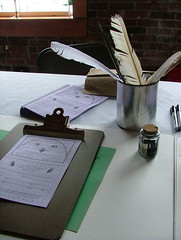
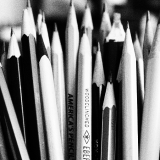
- Image by misfitgirl via Flickr
We writers have many tools.
We have our words, the nouns and verbs and adjectives and even the woefully despised adverbs, poor dears. We have our talent, our rare gift for putting the right words in the right order to make our readers weep, laugh, thrill, buy — or just turn the page. We have our minds, straining through the days and nights to create and hold onto the ideas that fill our words with meaning.
And we have our word processors. The tools we use to actually capture those ideas and put them down in words, the software and laptops and notebooks and ballpoints. These tools aren’t quite so glamorous. They seem so everyday, so mundane, so… boring.
And yet, there are few writers that aren’t infinitely fussy when it comes to their physical tools, who don’t demand just the right pencil on just the right paper, or who don’t secretly thrill at the prospect of a new notebook computer to carry down to that oh-so-perfect café. (We’re a little fussy about places, too.)
And why not? The tools we use to get our thoughts out of our head and onto paper (or increasingly, the screen) are the medium of our calling. You wouldn’t look askance at a painter who demanded the right brand of oil paint and a canvas prepared just so, right? A word processor or legal pad is a writer’s canvas; a keyboard or fountain pen her brush.
The truth is, there is inspiration in our tools. Just as the heft of a good chisel can make a woodworker itch to carve, a well-made writing instrument — whether a fine pen or a beautifully-designed word processor — can make us long to write, drawing from us the creative spark.
There are writers who write just to feel the flow of ink on the page (I’m one of them). There are others who are inspired by the shape of a font, the feel of a keyboard, the image of their words spilling across the screen (I’m one of those, too). I’m not kidding when I say that I was so impressed by Adobe’s gorgeous online word processor Buzzword that I wrote a book. Just so I could play with it.
Of course, there are writers who claim to be perfectly comfortable with a chewed-up #2 pencil and a student’s composition book. (Granted, it has to be a Blackwing 602 pencil and the composition books are imported from a stationer in France.…) But writers as a whole are especially prone to fetishizing our instruments, and with good reason: the way we write, the look and feel and smell and atmosphere of the experience of writing itself, affects the outcome of our writing.
Gertrude Stein wrote on scraps of paper on the dashboard of her Ford (which she called “Godiva”). Neil Gaiman writes with a fountain pen, in a Moleskine notebook. Lillian Jackson Braun, the author of the “The Cat Who…” mysteries, writes only on a typewriter. Speculative fiction writer Harlan Ellison is also a typewriter fanatic, whose devotion to his Olivia is well-known. Jonathan Lethem has given up his typewriter but remains committed to “the eternal Selectric of the mind” (as he told Slate in 2007) — he only writes in 12-point Courier, double-spaced of course.
And on and on. Some writers pick a specific tool for a specific book, like a musician who chooses just the right guitar for each song. Neal Stephenson wrote his epic Baroque Trilogy, which is several thousand pages in published form, in longhand with a fountain pen on cotton paper. Stephen King wrote Dreamcatcher with a fountain pen, too, saying it forced him to slow down and get into the story.
It might be irrational to find inspiration in our tools, to bind ourselves to the way a specific pen or pencil looks or feels. After all, the words, the tone, the rhythm, the meaning — these all come up from within, right? And yet we writers are irrational creatures by our very natures. Why else choose to spend long hours locked away alone as our preferred method of communicating with people?
Rational or not, investing our tools with the power to draw forth meaning from the depths of our beings is a very human, and very writerly, thing to do. It pleases us to use good tools, especially when we use them well. It’s all well and good to meditate on how we spin the raw stuff of everyday life into complexly woven tales rich with insight into the human condition, but we shouldn’t forget the less exciting but no less essential tools we use to relate those tales to the rest of the world.
They are, after all, tools of inspiration.





I use Microsoft Works Word Processor or WordPad on the PC.
I use a black pencil (Preferably Mirado or Ticonderoga) or mechanical pencils (only Vibs, .10 mm, I like the magenta best)
Paper… I like college-ruled notebook, but wide-ruled does as well. These are either in a binder or clipped to my red clipcase. Sometimes I use a journal. It has to have the right personality though.
Fonts… I think I like Times New Roman best. Story dictates size. Single-spaced.
You are absolutely correct. It is absolutely amazing how distracting (and disastrous) using a poor set of tools can be. If I’m not using the tool that I like, I am so distracted that I almost can’t work. When I write on the computer, I like to use Microsoft Word. I think that I’ve downloaded and tried every other program out there (including OpenOffice, AbiWord, Pages, KOffice, and the programs specifically for writers: Scrivener, Write Café, amongst others). Every last time, I come back to MS Word and the “soul crushing” blinking cursor.
While I’m not sure of the reason why, I think it comes down to habit and comfort. In most ways, I’ve learned to work with Word instead of fighting it. When I use other programs or tools, I spend far too much time thinking about how to accomplish a piece of formating rather than focusing on how I want to set up my ideas. This just isn’t an issue in Word.
Terrific post! If the old adage is true that a poor workman blames his tools, then it stands to reason that good ones probably praise theirs! 😀
My favorite writing instrument is a trusted old Parker “51,” which I use for taking notes and jotting ideas. For my journal, I use a Parker “Vacumatic” that was a gift. I do most of my work and fiction writing in Nisus Writer Pro on an old Mac PowerBook G4. I’m also a big fan of the Zebra 301 line and my mechanical pencil of choice is the cheap-but-rugged Sanford Logo.
I agree with Rob above, I think it’s about habit and comfort. Vive le difference!
i’ve been a scribbler off and on for over 40 years, tried a thousand ways of writing and these days … a Lamy 2000 Extra-Fine with Platinum Carbon Black Ink cut 1:1 with mineral water on Clairfontaine cloth-bound A4 notebooks. who’s neurotically obsessed with the tools?
I use a Lamy 4‑color pen, which is great for creative thinking and hand-drawn mind maps, plus several different sizes of Moleskine notebooks. Having high-quality tools DOES make a difference, I’ve found!
Those square bics that most people hate and looseleaf. Or q10 for longer pieces.
If I start on paper I have to finish on paper. If i start typing I have to finish that way. I rarely switch mid-story.
i’ve been a scribbler off and on for over 40 years, tried a thousand ways of writing and these days … a Lamy 2000 Extra-Fine with Platinum Carbon Black Ink cut 1:1 with mineral water on Clairfontaine cloth-bound A4 notebooks. who’s neurotically obsessed with the tools?
Can’t do without my iPhone, yellow legal pads and earplugs.
» to carry down to that oh-so-perfect café. (We’re a little fussy about places, too.)
Don’t you dare sit in my seat at the café…That’s my seat! Out! Now!
lol — Nice post.
Doug